Showing posts with label Teaching. Show all posts

Thursday, November 8, 2012

SmartBoards as essential teaching tools?

  This topic came out of a discussion with the elementary teachers in my school about wanting SmartBoards in their classrooms. I want to point out that I'm not intending to specifically respond to them. I've realized I feel a specific resistance towards SmartBoards in myself that I want to explore in this post. I hope no one feels attacked. Also, I use the term SmartBoards even though there are a number of other companies that make devices that compete with Smart Technologies. Much like Kleenex, and even more so in technology, we tend to attach ourselves to whatever came along first. If you don't believe me open a word processing document and look at what the save icon is. That's a floppy disk. Now try to think of the last time you used a floppy disk -- no, that was a zip drive -- there you go.

  Secondly, I want to be sure that everyone who reads this knows that I'm not arguing against using the SmartBoard in your classroom. If you have one, use it. I'd rather have one than not, and there are thousands of uses for them. This article is to discuss if having a SmartBoard in every classroom should be considered necessary technology in the same way that a whiteboard or chalkboard is commonly found in every room.

What you find in a teaching station

  When you walk into a classroom what do you expect to find? There will be desks or tables, chairs for the students. Usually you'll find a teacher's desk of some sort, storage for supplies. The teaching station is specifically the area around some sort of desk or podium on which technology resides. My current teaching station is comprised of a laptop, extra monitor, projector, speakers, and a whiteboard. I have a pull down screen but I'd rather just project directly on the whiteboard. Last year this also included a microphone, built in speakers, scanner, keyboard and mouse, computer dock, student clickers, and a SmartBoard.
Teaching station at University of San Francisco
  I, along with most teachers I know, use the computer and projector every day. Speakers are frequently used and are easily worth adding considering their low cost. The whiteboard has definitely become industry standard; there are still some teachers that use blackboards and to some degree the white board becomes more of a static fixture in a room with a SmartBoard. The extra monitor I find incredibly useful with the projector as I use the spare to show what is on the screen behind me running an extended desktop rather than just showing what is on my screen to the world. It allows me to have my grade book, email and other more sensitive files open on my computer without having to worry about accidentally showing it off to my students. Plus the additional screen space when trying to create presentations and pull information from the web prevents me from having to flip back and forth between multiple windows as often. I could live without the extra monitor, but with cheap monitors running around $100 it seems to good a deal not to buy.

The SmartBoard Question

  When I had a SmartBoard in my room during my student teaching and last year, I used it every day. I only used the whiteboard for random breakouts during math and to post the weekly homework for everyone to see. Almost all classwork, entry task assignments, and corrections were done with use of the SmartBoard and projector. There were other teachers that used the SmartBoard for a number of purposes that I'll discuss later on here. Needless to say, they were used, heavily. The question I'm curious about is if they're worth the cost. Not if they serve a purpose.
  Looking at the cost we see that the current range for interactive white boards is between $1000 and $4000. I've seen a few conference sessions about making your own using a Wii which could significantly decrease the cost. While practical on an individual level this isn't the sort of decision that is going to be employed across a district. Additionally to the fees for buying the board is the cost of mounting both it and the projector. While the projector is necessary technology mounting it isn't necessary, even if it is best practice. So we should probably assume in the $2500 range for this piece of technology in order to get it a significant size, assuming that the teacher has all the other equipment to make use of it. Sizes of up to 94 inches are available but the cost also increases significantly.

The Issues 

  Unlike a projector screen (or as I'm currently doing just projecting on a white board) there isn't much flexibility once the smart board is in place. While a mounted projector can be turned off and the board used for other purposes, the interactive white board takes up prime classroom real estate all the time. It goes front and center. While I've used a smart board on wheels that could be rolled around the continual need for adjustment really makes this not worth it. The dead center of your teaching pallet is basically reserved for the machine. While this isn't a massive issue all the time it can be frustrating when you want to draw a timeline across your entire white board.
  Newer boards are getting to the point where multiple touches are standard allowing for multiple students to use the device at once. One problem I encountered was having multiple students work on the space at the same time.
  Size is becoming less of an issue. 77in seems to be the new standard which does meet the needs of most classrooms. My own projector is currently running at 68in diagonal and is meeting my needs just fine. Some of the earlier versions sat at 48in (they're still available) which ends up being horribly small for most classroom uses. Boards this size are still useful for conference room type settings but they don't really function in a classroom.

The Uses

  There is a handful of specific uses that you can do with a smartboard that you can't pull off with just a projector. The first one is easy display of functioning websites. A presenter doesn't need to go back to a computer to forward slides or click on webpages. While a clicker does perform several of these functions, the ability to easily click on hyperlinks has significant value.
Smart Technologies
  One other advantage is that you can use the screen as a giant iPad. I've seen teachers use this for organizing games, students taking their own attendance, or several other uses. It allows anyone access to come up and manipulate what's on the screen without having to get access to the teacher's computer. I've utilized this both as a large interactive whiteboard as well as putting online worksheets on the board and I can write on the directly.
  One of the biggest features of an interactive whiteboard really isn't that valuable in most classrooms. The ability to save work on the board. This was described to me as highly valuable in engineering scenarios where people are doing a long series of design type work and want to share and keep the results. In my math classroom it hasn't been necessary. I've used it for lists in language arts but this was more for dramatic effect than to actually save the specific work done. It does allow you to quickly copy down what is on the board and move on to a fresh screen. You can move on without actually erasing anything. This means earlier problems can be brought back up in the same session. This is valuable, though not vital.
  I feel that the full picture of uses hasn't been fully developed for interactive whiteboards but the technology is quickly being eclipsed by tablets. If information can be pushed to student tablets they gain all the touch functionality that you would have with the screen at their desk. I'm sure there are all kinds of creative things that can be done with touch screens but I don't feel that realistically most teachers will optimize their usage.

Cost Benefit Analysis

Apple iPad
  Bearing the $2500 price tag is really a big deterrent to bringing Smartboards into every classroom in my opinion. With the current price of tablets reaching down into the $200 range, paying the price of 10 tablets to outfit a classroom with a piece of technology with no mandatory uses feels like a significant waste of money to me. The Smartboard from 3 classrooms could give an entire set of tablets to one classroom.
  While it definitely does cool stuff I don't see enough practical uses in most classrooms. Perhaps in a college science setting or maybe even advanced high school math there are some reasons why people should have one. But overall I feel that this is more of a want from people than a need. In a classroom a Smartboard is a big shiny. It's something that stands out as cool and fun. But it just doesn't bring with it the educational bang for its buck that makes it a necessary investment for schools.

3D Game Lab, First Update

  As part of the teacher camp for 3D Game Lab they want us to note down things in a journal or blog of some sort. Rather than use their internal tool I'll share things here.

  First off upon getting in you have the ability to easily pick the starter quest. Completing it leads you to 4 new options. I'm not entirely sure that the titles picked by the creators were as good as possible for these quests as I didn't want to click on one because it seemed to exist only for the purpose of making a report of an issue. Actually it was a required quest that showed me how to make a report. Important lesson, name your quests well.

  I also very quickly found that I wanted to earn more XP. I simply couldn't help it. One more quest, this one is worth 25 xp. That bar could get more filled -- I got a rank up -- I have more quests available, I should look at them before I log off -- maybe I'll just do this one -- or two. Now I'm a big fan of learning so maybe this is personal and won't be as present in my students. But the simple fact that I can see my work increasing a score makes me want to get a few more points.

  From a teaching and learning perspective this is fairly revolutionary. Students are generally given a task that may or may not be graded. If they do well, they are rewarded with a good grade. If they do poorly, they are punished with a bad grade. That's the end of the story. Perhaps a teacher will give students the chance to return to their work to try to improve their grade. But these are generally only awarded to students with significantly inferior scores. The student with a B that will keep working until they get an A is generally left in the dust. 
  Here suddenly we can go beyond this model and actually hold all students to a higher standard. It's not done until it's A work. But you can keep on working on it until it gets there. It becomes a great way to always be moving forward without the millstone of previous failures. If learning is about making mistakes, why doesn't everyone get the chance to try again. 

Monday, October 22, 2012

What's a Tech Teacher to do: Pirated Software

  I ran into a very interesting struggle as I was working with my Juniors. I wanted to see if anyone could successfully log into the Minecraft server I had set up so I asked them who had a copy of Minecraft. About half a dozen hands shot up. So I asked if one of them could log into my server. One student stopped to ask if he needed a legal copy of Minecraft to log in. When I told the class that the server was an account verified server suddenly there wasn't anyone able with an account that could log in.
  Interesting factoid #1: 1/3 of my students have a copy of Minecraft. None of them have paid for it. I then found myself having to ask my other classes if anyone had a "legal" copy of Minecraft. Surprisingly enough, it was the 6th graders who had a number of students (3) with actual legal accounts.
  Interesting factoid #2: The most common response I got to my question about a legal copy was "oh, no, mine's not legal". Students were open and ready to admit that their software was acquired through less than savory channels. The simple fact that I had to ask about a legal copy indicates an interesting posture on the use of pirated software.
 
Teaching with Regards to Pirating
  So where does this leave us as teachers of technology. I can't be the teacher who ignorantly preaches total opposition alcohol while going home to drink a glass of wine. I can't just say it's bad don't do it. I also can't really discuss the legal implications of taking this action. Students already know their actions are illegal, it is evident in their language. Realistically teaching the about the punishment if they're caught won't really work either as the chances of an individual getting busted for pirating software is incredibly low.
  So what can I teach? In the end I'm forced to view pirating software much like speeding. It's possible to get busted for it, but that's not where the real danger lies. The issue with speeding is that it is dangerous. This doesn't mean that people don't speed. It means that they need to understand what it means to speed, how much danger it puts them in, and how to react when something does wrong. Most of us would barely call speeding illegal. It is more of something we could get in trouble for but is totally okay to do.
  There are a few very valuable lessons that can be taught surrounding pirated software that go beyond "it's bad, mmkay?". This is necessary primarily because attempting to oppose pirating on a purely moral basis simply won't work. Speeding is illegal because it puts others in danger and ourselves. We know this, but that alone doesn't change the behavior.

The Teaching Points on Pirated Software
  The dangers of pirated software come from an understanding of working with people that are operating outside of the law. Much like the dangers of druggies and drug dealers. These are people that are willing to act outside of the law with regards to how they make a living. If someone is willing to evade police in order to sell drugs, they're probably willing to rip you off or steal money from you. You can't exactly report to the police that you were scammed trying to buy drugs. Similar things exist in the realm of pirated software.
  Someone who is interested in cracking software to make it publicly available may not be doing so for purely altruistic means. When you're not getting software directly from a trusted manufacturer you don't know what has been altered or imbedded in the installation files. Viruses, spyware, and other possible infections are fairly common among pirated files. Even if you find a file that looks like it is from a trusted pirate source, you don't know if someone has simply repackaged it to include a virus. However, these aren't the only dangers.
  I'm constantly reminding my students that we are on a publicly owned network. The school is publicly owned and students need to behave appropriately with its resources. The same may apply in future business situations. Students simply can't use the school network for illegal purposes. When something goes out to BitComet I get a report back and have to deal with it. Simply being aware of who has access to your network information may play a significant role in understanding the dangers of pursuing illegal activity. Especially since your home IP knows every website you've been to, every search you've made, and every file you've downloaded. The information is recorded that you have been doing something illegal. At school you might lose access to the network. At home, we don't know what the long term implications will be, but your information there simply isn't exclusively private.
  The final teaching point is the danger of using pirated software for business. While downloading a game and playing it at home poses minimal risk, creating media with illegal software can be catastrophic for a business. Personal use is a difficult thing to nail down. But a company that makes a product using illegal software is open up to much more liability than an individual using something illegally. This is why it is incredibly important that legal enterprises have legal copies of the software they are using.

Conclusion
  I feel that reasonable tech people can't simply teach that pirating software is wrong. This kind of moral teaching just won't go far enough to reach students. In a similar way we can't simply teach students that violence is wrong, sex is wrong and name calling is wrong. Each of these things have their place in the world. The important piece is to teach students to understand the dangers and consequences of these things. With this understanding they can find their own place in the world, rather than trying to fall into a proscribed idyllic and totally hypocritical perfect student or person.

Saturday, September 15, 2012

How Standards are Reprofessionalizing Teaching

and Why Teachers Hate Them.

   Mentioning state standards, or common core standards, in a room full of teachers is sure to bring forth a varied response. However, the variance usually ranges from general displeasure to raw hatred. I'm not talking about the legendary teachers of the Michelle Rhee firing sprees that are filling the seat only to collect a paycheck. I'll be honest, I don't know any of those. I'm talking about good, dedicated teachers with creative styles and numerous effective ways to engage students. Standards have left a bad taste in their mouth.
  I can assure you this isn't because teachers don't feel that it makes sense to set some sort of expectations on what students will learn in certain grades. I have no doubt that every teacher has expectations of what their students should have known before they entered their classroom and expectations about what they will know when they leave. It also isn't because teachers are lazy, illiterate bumpkins that just want to use last year's worksheets. Of the many colorful words I can use to describe my worst teachers in my own education, lazy simply isn't one of them. I think we have to give teachers the benefit of the doubt that there really is something wrong with standards that is riling them up.

  One of the first issues teachers run into with standards is that they are absurdly general. Take the following example from 6th grade Social Studies in the Washington State ELARs "Understands the role of government in the world’s economies through the creation of money, taxation, and spending in the past or present." I've taught 6th grade Social Studies and I'm not sure I understand the role of government in the world's economies. The lack of clarity is daunting. To what level must they understand the role of government, by creation of money are we talking printing money or propelling economies through government debt, and most of all does any one out there actually understand the world's economies? Let's not forget, this is a 6th grade standard. We're talking 12 year olds here. Most of them struggle to remember to bring in 25 cents on Friday for popcorn and seem surprised that I won't give them my money because they forgot theirs.
  If the standards aren't difficult enough to comprehend and apply to every day teaching there is always the fluid nature of them to consider. Since 1989 there have be no less than ten different sets mathematics standards that have crossed math teacher's desks. At best a long running set of standards could stick around for 3 or 4 years before being eclipled by a new set. A timeline can be found HERE which details the numerous state and national standards and changes that have been implemented to them. Sometimes new sets didn't supersede the old sets, they just applied on top of them giving teachers more to cover within the same timeframe but without adding school days in which to get it
done. With Common Core around the corner there has been a number of online resources put up to "aid teachers" in professional development. However, most teachers have not received any professional development hours from their district to make this change. New sets of standards often times mean teachers must independently make the shift to a new set of expectations that will probably fall to the wayside before they get fully realized in the classroom.
  The final piece that really gets teachers fired up is that standardized test scores on these standards are now threatening to be used to judge a good teacher versus a bad teacher. If I'm teaching a class in which I have a student that for reasons out of my control misses class at least once a week, I'm now being judged based on what I can teach them in 140 out of sequence days of a set of standards that I could never fit into 180 days to begin with. This same set of standards that I can't actually figure out what they actually mean, I've never been trained on, and seem to change on a 2.5 year cycle. And if kids that came into my class three grades behind the expected place leave at one year behind, I'm still considered a failure. Yeah, standards kind of suck the big one.

But...

  Oddly enough, teacher's hatred of standards and everything that gets balled up with them misses the good that they have done our profession. Anyone reading through the endless lists of standards quickly begins to realize that they are so wonderfully general, vague, and unclear, that it actually allows teachers to do what we entered the profession to do -- reach students. After so many years of very bad scripted curriculum (these years aren't over by the way, there's just now ways to fight back against them) teachers are beginning to enter their classroom armed with knowledge of the standards and the burning desire to reach students at any cost.
  When all you have is a curriculum book and you're told to teach, you're hamstrung before you even get into the class. You have to follow that book through thick or thin. Admittedly this is still the case in many districts. However, for those willing to fight for it, the standards provide excellent protection for those interested in real teaching. Rather than being bound by stale curriculum, a teacher can find a method they feel will reach students and tie it to standards with many interesting results.
From zombiebased.com
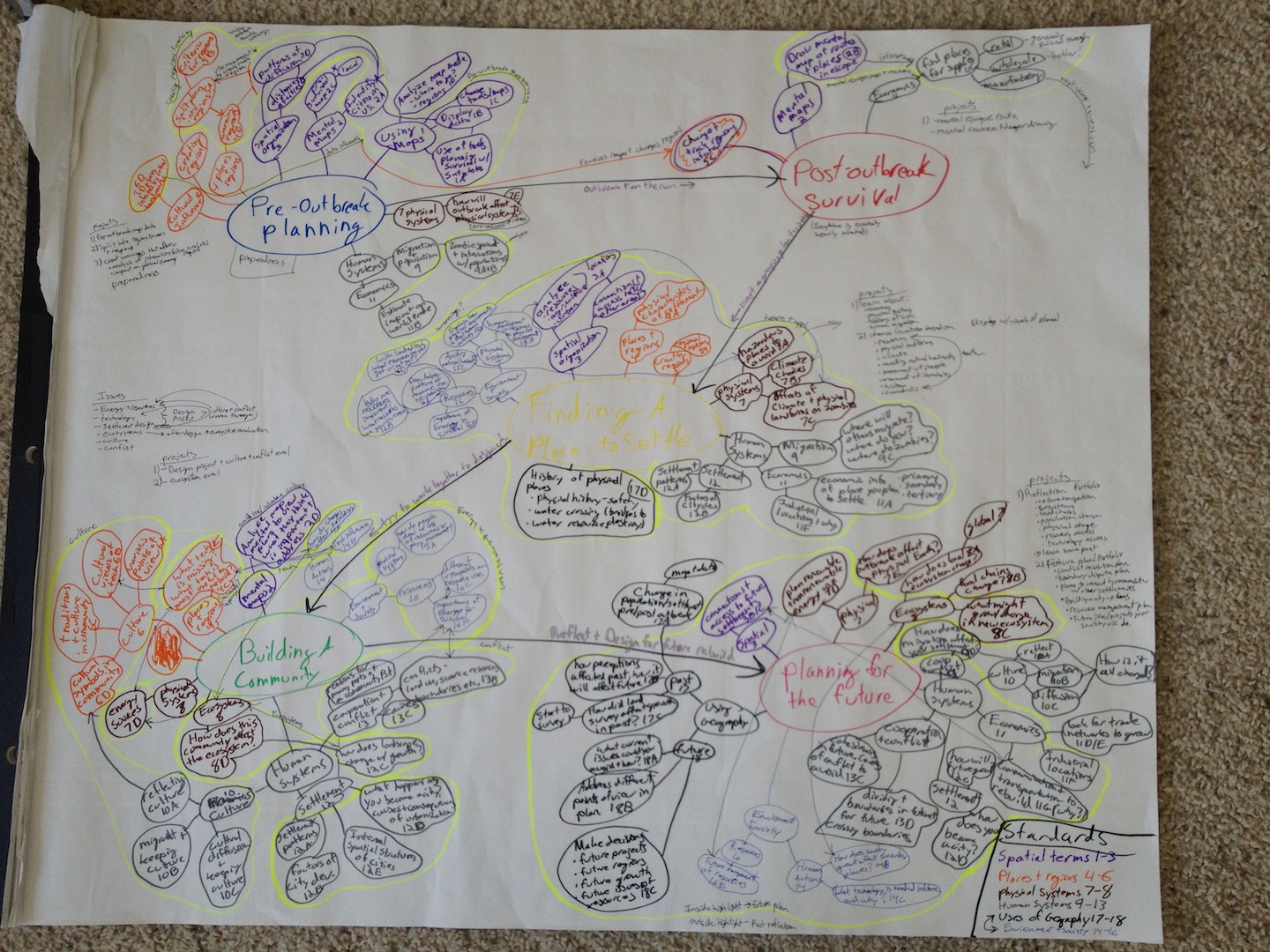
   Take the zombie based learning curriculum which meets a number of Washington State Standards and I'm sure will also be adapted to meet common core standards as well when they come out. This is something that would be totally unimaginable in a prestandards teaching environment. But when you look at the web of social studies standards that David Hunter created, you can't argue that the teaching is irrelevent simply because you don't like it. It has official support in the form of goals that were created by the state to say what students need to learn. In short, teachers are empowered by standards because they only say what students should learn, not how to teach them.
  When a teacher builds an activity and ties it to standards, the pressure is removed from the teacher to prove that their teaching effective. They have a clear list of the standards that the activity is aimed for and this presents clear goals for the students. It places the burden of proof on the district and administration's to show that the lesson is not actually successfully teaching those standards. This is a much harder argument to make and one that most districts simply won't pursue. Considering that the teachers that are going out of their way to develop specialized curriculum that meets their student's needs as individuals are going to be the teachers taking the hard route for the good of their students, there is little concern that these teachers will be trying to support substandard curriculum with standards. It is for those teachers who are fighting for the academic freedom to actually teach the students in their room that the standards can be a fantastic tool.

  When so much energy is being put into deprofessionalizing teaching through scripted curriculum, standardized testing, automated testing, and distance learning, Having a solid group of standards to base your own projects and lessons around gives teachers the edge they need to show how vital their work really is. If standards could be consistent, comprehensible, fair, and trained, they could allow teachers to create the classrooms that they entered the profession to have. Ones full of creativity, activity, and fun.


A few examples below are some Washington state standards and potential out side of the box curriculum teachers.

6th grade social studies - Constructs and analyzes maps using scale, direction, symbols, legends and projections to gather information.


 Possible Curriculum: StarEdit (starcraft's map editing tool), Civilization, treasure hunts, Geocashing

8th grade social studies - Analyzes how the forces of supply and demand have affected the production, distribution, and consumption of goods, services, and resources in the United States

in the past or present.


Possible Curriculum: Settlers of Catan, Ticket to Ride, Any Tycoon Game

6th grade mathematics - Determine the experimental probability of a simple event using data collected in an experiment.


Possible Curriculum: Any survey, board game, RPG, dice game or gambling game, ever.


Friday, August 10, 2012

Letters of Love

  A classmate of mine in the Evergreen Masters in Teaching (MiT) program named Monear said something I'll never forget. It was during our student teaching seminars where we would gather once a week and share struggles and successes of the week, and review our work on the ungodly project that went along with student teaching. Monear and I didn't agree on most things, I wouldn't ever say we got along well. But this was the most important thing I learned in my two years of teaching education.
  She said, "The great thing about teaching... is that you get to fall in love with 150 students. The only problem is," her voice cracking at this point from the stress and emotion of the work we're putting into countless hours of prep for student teaching, "it's really hard to be in love with 150 different people at once."
  This year I must be fortunate, I only have 75 students to fall in love with. I'll be honest, I don't find loving them hard. I find it a little too easy.
  My application essay when I was applying to the MiT program was focused around a discussion on how we care for those we help much more than those that help us. This realization I came to a few years ago was based around my experiences with the growth of my own daughter, and relating that to a distancing relationship with my own parents as holiday visits had to become less frequent and my own life more stable. The idea became clear to me that when someone extends themselves to help another, they have invested significantly more into the other person than the person being helped has invested in them. In this way the success of someone you've invested into of greater interest.
  I've spent the last year investing my life into 75 students, specifically the 25 of my homeroom with whom I average about 2 hours per school day with. They are 25 twelve year olds with interests ranging from hockey to Magic, and poetry to makeup. A very diverse, talkative, and typical group of 6th graders.
  In following with a tradition that I saw done by a Spanish teacher at Lincoln High School in Tacoma named Hannah Chin-Pratt, I wrote a letter to each of my students at the end of the year. These letters were straight from my heart. Talking about struggles I'd experienced working with them, great things that they've done, things I'd come to expect from them over the year, and areas that they've grown. It also included some final words of advice as they move onto middle school. Some were funny, some were direct, but all were heartfelt. Even while writing them, I ended up shedding more than a few tears.
  When it came time to give them to my students, I was pretty apprehensive. I wasn't going to wuss out and hand them out silently like a student passing a note in class. These were my feelings and if my students were going to learn anything it'd be to show how you really feel. I was going to pull each student up in front of the class, and read their letter. I started in the back of the alphabet. I told the first student how proud I was of him working on paying attention to how what he said would affect those around him, even if they weren't listening. He apparently spent the next period proudly reading the letter aloud to his next class, even though most of the students were there when I read it to him. The next student I told that no one can make her feel bad unless they let her and remember that sometimes you are the best at something but other people won't realize it. Her mother let me know that on the way home she broke down crying and was incredibly pensive for the rest of the night.
  And so the time went on, tears frequently streaming down my face, my voice cracking every few letters. But I read every student their letter. Told them I was proud, concerned, and that I cared about them. I showed them that I knew them, I was on their side, and that I loved them.
  My relationship with many students altered that day, but not totally. The next day some of the usual rowdy behavior showed up on the field trip; students were asked sit down, not scream, and spit out their gum as usual. But there was a certain shyness in glances I got from students; nods of approval from some of the boys. It was as if something intimate passed between us in that letter. They knew that I knew. They knew that I cared. Like a smile you share after a first kiss with a girl you're interested in, you know things are going to be different. Better, somehow. Knowing that they like you too.

Monday, July 30, 2012

Why can't school be like this all the time?

  Last week was the Bainbridge Island first STEM (Science, Technology, Engineering, and Math) camp. I was lucky enough to be selected as one of the teachers to participate in the inaugural edition of what is sure to become an annual camp. It was a week long day camp with students broken up into their interest area in either Science, Technology, Engineering, or Math.

  There were 8 Bainbridge Island Teachers (from Sakai, Woodward, or Commodore) to support approximately 100 students. There were also 20 volunteer counselors from Bainbridge High School. Needless to say, this was an ideal learning environment.
  
  The week progressed with each morning having a spectacular science type event followed by three one hour and twenty minute periods spent in your primary class. The entire week held a space theme and we even had a visit from a brilliant NASA astronaut, John Fabian. Students spent the week making rockets, programming robots, building solar cars and editing videos. Students were engaged, intrigued, and learning.

  To get an idea of what the week was like watch the following video which was made by the students in my Technology class:

BISD STEM Camp Video 2012


  This brings up the question, why isn't school like this all the time? Students are heavily engaged in critical thinking, problem solving, hands on learning, storymaking, programming, and just about everything else we'd possibly want for our future engineers and scientists. Students were using angles to calculate the height of the rocket and movement of robots. They were bringing details together to create a narrative about a specific class looking at basic story elements. They were doing 3d modeling and printing their creations to test a hypothesis. Is there really anything more we want?

  There are a few things here that are possibly worth looking at. First off, what students are learning can't be tested. We have some kind of sick fascination with the belief that learning that can't be tested isn't real learning. Over the past year, I feel some of the best learning done by my students wasn't on any subject that could be tested. The most important skills aren't knowledge but social skills, confidence, and self advocacy. We can really only test knowledge. This leads into the next issue about what shows up on standardized tests and state standards.

  For anyone who's read any of the Washington state standards (and leading into the Common Core standards) you'd know that these standards are actually a very good target for learning. They are aimed at broad conceptual points and include the ability to think and analyze, not simply regurgitate. However, somewhere between the standards and the curriculum, this gets lost. Again, if you can't test students to show your curriculum works, how can you sell it as successful.

  But the camp was successful, students learned, and there was no test at the end. Would a test have driven more students to work harder? I doubt it. It also would have made the entire process less fun. But I'm not sure that we could guarantee the same success with 28 kids and no assistants. We had a 1 to 12 student to teacher ratio with 2 high school volunteers per 10 students. We also had a $200 budget for the week per class. I know that public education can't successfully work that way. But maybe if it was just a little more similar...

Saturday, July 21, 2012

3D Game Lab Camp on the horizon

  On top of everything else going on in my life (moving, new job, baby due in August, brother in law's wedding) I'll be embarking on designing my technology classes using 3D Game Lab for the upcoming year. This will be the basis for assignments in my three technology classes next semester. In the future I'll be updating what this looks like in practice.

  For those not familiar with 3D Game Lab it is a web based program being designed by the Boise State University to track student achievement in an experience point completion based model. What this means is that a student has a number of options as far as assignments (called quests) to choose from and each will give an experience point reward upon completion. Completion of certain quests may unlock other quests and the instructor may grant certain awards (called badges) for students that deserve something special for completion of a particular assignment.


  In this model student grades can be based on the experience points that students earn as well as earning certain badges. An expectation for a student may be to earn 1000 exp to get an A as well as complete 3 badges that signify content area completion. However, earning these badges will only grant 500 of the total experience required allowing students to pick which assignments they will complete to earn the remaining points. An instructor could have 3000 possible points from quests allowing students to pick a number of areas that they wish to focus in or allow them to spread out and experience a number of particular areas.

  With a clear goal at the beginning of the quarter or semester, students can pace themselves to reach their necessary goals. Students can also repeat an unsuccessful quest to learn the material and show mastery. Consider how different this is from traditional education. In a traditional classroom you learn teacher selected material and then are tested to prove your knowledge. If you fail to show mastery you are punished with a bad grade and the class moves on to a new subject. If you succeed, you are rewarded with a good grade and are forced to move on to a new subject, regardless of your interest in the area you've just completed.

  This very model turns education on its head. It is student directed and standards based, with clear expectations and endless options. Students are working towards a clear goal at their own pace. They can pick the assignments that fit their interests, current mood, or time available. The education is accessible at home, at school, or anywhere that there is an internet connection.

  Of course this model does have its problems. First off it basically requires a 1 to 1 student/computer ratio. I happen to be fortunate that I have this option in my upcoming position, even if it is just limited to netbooks. Secondly, it assumes that quest completion is equivalent across the board. Regardless of how any one quest was completed, students are essentially awarded the same experience. While instructors have the option to send a student back to do more work on a quest before it is completed, there is something inherently different from a student who is able to complete work successfully the first time with  minimal guidance, and the student that may finally complete it after submitting seven failed versions. Finally, it is still product oriented. Students are required to build something and are ultimately judged on the product rather than the process. Unfortunately, learning remains a process, not a product. I've learned tons by creating something crappy, and I've created things perfectly but didn't manage to learn anything. I'm not sure that this problem can really be successfully addressed in education, but I'm not afraid to hope it can.

  I'm curious to see how this plays out in my classroom and I look forward to make additional reports. While it is clear that education is not the panacea of society, it may be that the internet is the panacea of education.

Friday, April 13, 2012

Review, Remember, Retest, Relate


            So I did an interesting thing in my class yesterday. I gave a geometry test in which the front page was the exact same as a test that I had given back in November. I must say, I was both surprised and disappointed with the results. What surprised me were the results and the stratification that was exhibited.
            For the most part students who performed very well on the first round of the test performed equally as well. These are students with a strong understanding of mathematical concepts and most of the have assuredly been doing math longer and more often than their counterparts. These students generally do well and could have probably handled the majority of this page with only the equations I presented even before I taught the unit.
            It was the students that struggled to pull their work up to an acceptable level by the end of the unit that still struggled significantly. Many of these students had worked hard, very hard, to gain an understanding of the work four months ago. However, for many of them, it simply didn’t sustain. These students had managed to handle the Monday-Friday problem, but really hadn’t advanced significantly in their learning five months later.
            I’m beginning to wonder if fully summative testing is the only way to see what knowledge sticks. I had one student who astutely asked me why he couldn’t remember how to find the area of the shapes in question. I answered by asking him what they best gun in Call of Duty: Modern Warfare 3 (MW3) was.
He quickly piped up with “The MP7, but everyone thinks you’re lame if you use it.”
“What does it look like?” I asked.
He then described the gun in great detail as well as the social ramifications of using it.
“You remember what you use.” I said as I walked off to answer another question.
The chorus of “Ahhhh” that my comment drew from the table was illuminating. Every student at that table played MW3, understood the reference, and knew the gun. None of them reliably remembered how to get the area of a parallelogram.
I remember using the peg board in 2nd grade to solve square roots. While I don’t remember the exact process, I remember enjoying it and if I had all the same materials I could probably recreate it. I kept asking for more and more difficult square roots to figure out. I enjoyed it. I remember researching the Loch Ness Monster for my 6th grade project and writing the report on it. It was fun, engaging, and even as I read it now, well written.
I also remember how to get the area and circumference of a circle, how order of operations works, and how to divide and multiply fractions. But even after working as an IT recruiter for five years I can’t reliably spell consultent consultant or recieve receive. You remember what you use. Or something like that.
I think that the groundwork for some kids has already been built that when you discover length times height equals area it fits in and they move on. There are some that can’t even remember what area refers to. Education is doing great things for the first group, but I can’t help feeling that no number of repetitions will ever get it to click with some other students until some different framework has been established. How to we reach back to build that framework for the kids that need it, and where did it even come from with those that have it?