Showing posts with label Testing. Show all posts

Saturday, September 15, 2012

How Standards are Reprofessionalizing Teaching

and Why Teachers Hate Them.

   Mentioning state standards, or common core standards, in a room full of teachers is sure to bring forth a varied response. However, the variance usually ranges from general displeasure to raw hatred. I'm not talking about the legendary teachers of the Michelle Rhee firing sprees that are filling the seat only to collect a paycheck. I'll be honest, I don't know any of those. I'm talking about good, dedicated teachers with creative styles and numerous effective ways to engage students. Standards have left a bad taste in their mouth.
  I can assure you this isn't because teachers don't feel that it makes sense to set some sort of expectations on what students will learn in certain grades. I have no doubt that every teacher has expectations of what their students should have known before they entered their classroom and expectations about what they will know when they leave. It also isn't because teachers are lazy, illiterate bumpkins that just want to use last year's worksheets. Of the many colorful words I can use to describe my worst teachers in my own education, lazy simply isn't one of them. I think we have to give teachers the benefit of the doubt that there really is something wrong with standards that is riling them up.

  One of the first issues teachers run into with standards is that they are absurdly general. Take the following example from 6th grade Social Studies in the Washington State ELARs "Understands the role of government in the world’s economies through the creation of money, taxation, and spending in the past or present." I've taught 6th grade Social Studies and I'm not sure I understand the role of government in the world's economies. The lack of clarity is daunting. To what level must they understand the role of government, by creation of money are we talking printing money or propelling economies through government debt, and most of all does any one out there actually understand the world's economies? Let's not forget, this is a 6th grade standard. We're talking 12 year olds here. Most of them struggle to remember to bring in 25 cents on Friday for popcorn and seem surprised that I won't give them my money because they forgot theirs.
  If the standards aren't difficult enough to comprehend and apply to every day teaching there is always the fluid nature of them to consider. Since 1989 there have be no less than ten different sets mathematics standards that have crossed math teacher's desks. At best a long running set of standards could stick around for 3 or 4 years before being eclipled by a new set. A timeline can be found HERE which details the numerous state and national standards and changes that have been implemented to them. Sometimes new sets didn't supersede the old sets, they just applied on top of them giving teachers more to cover within the same timeframe but without adding school days in which to get it
done. With Common Core around the corner there has been a number of online resources put up to "aid teachers" in professional development. However, most teachers have not received any professional development hours from their district to make this change. New sets of standards often times mean teachers must independently make the shift to a new set of expectations that will probably fall to the wayside before they get fully realized in the classroom.
  The final piece that really gets teachers fired up is that standardized test scores on these standards are now threatening to be used to judge a good teacher versus a bad teacher. If I'm teaching a class in which I have a student that for reasons out of my control misses class at least once a week, I'm now being judged based on what I can teach them in 140 out of sequence days of a set of standards that I could never fit into 180 days to begin with. This same set of standards that I can't actually figure out what they actually mean, I've never been trained on, and seem to change on a 2.5 year cycle. And if kids that came into my class three grades behind the expected place leave at one year behind, I'm still considered a failure. Yeah, standards kind of suck the big one.

But...

  Oddly enough, teacher's hatred of standards and everything that gets balled up with them misses the good that they have done our profession. Anyone reading through the endless lists of standards quickly begins to realize that they are so wonderfully general, vague, and unclear, that it actually allows teachers to do what we entered the profession to do -- reach students. After so many years of very bad scripted curriculum (these years aren't over by the way, there's just now ways to fight back against them) teachers are beginning to enter their classroom armed with knowledge of the standards and the burning desire to reach students at any cost.
  When all you have is a curriculum book and you're told to teach, you're hamstrung before you even get into the class. You have to follow that book through thick or thin. Admittedly this is still the case in many districts. However, for those willing to fight for it, the standards provide excellent protection for those interested in real teaching. Rather than being bound by stale curriculum, a teacher can find a method they feel will reach students and tie it to standards with many interesting results.
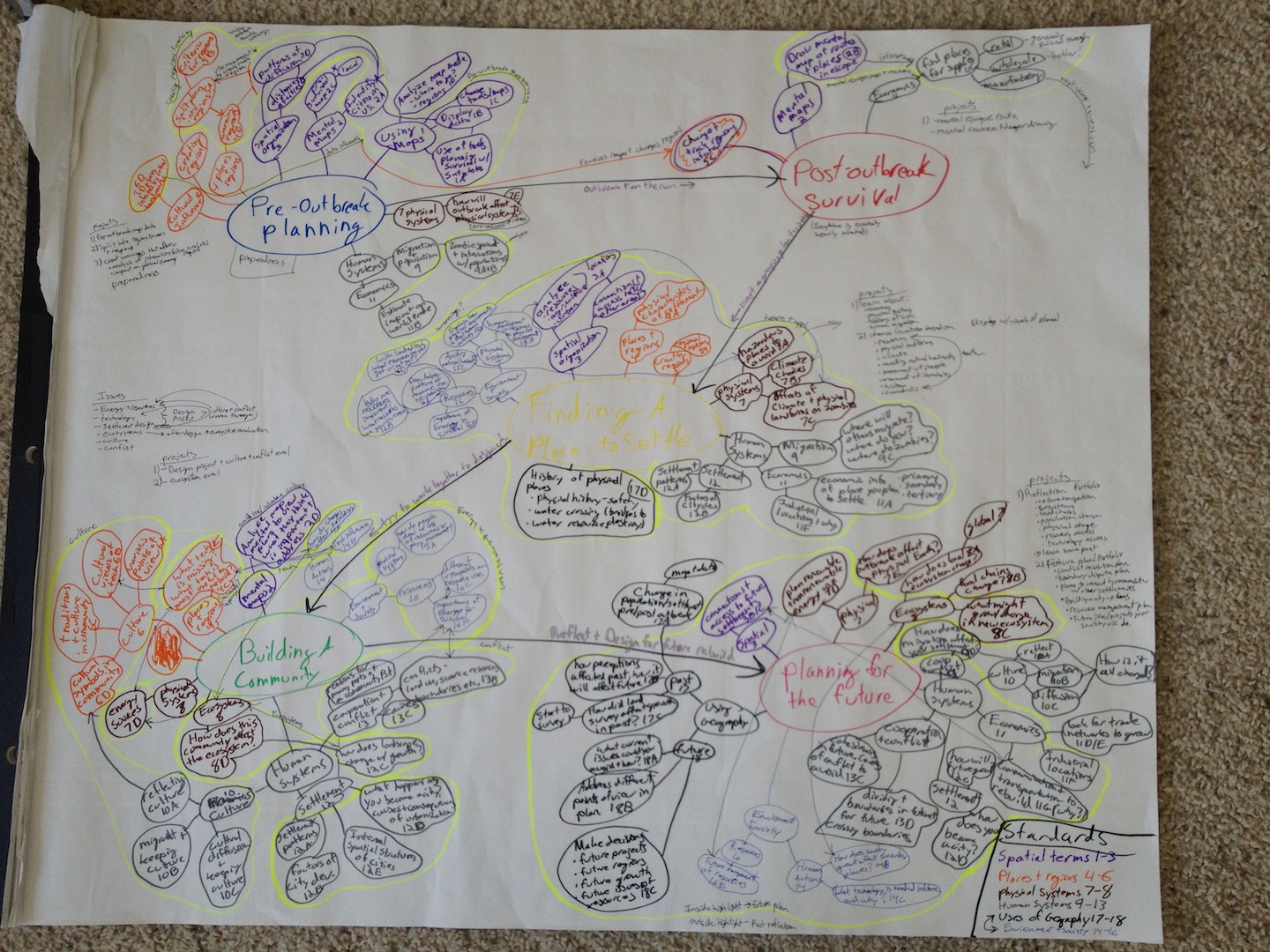
From zombiebased.com
   Take the zombie based learning curriculum which meets a number of Washington State Standards and I'm sure will also be adapted to meet common core standards as well when they come out. This is something that would be totally unimaginable in a prestandards teaching environment. But when you look at the web of social studies standards that David Hunter created, you can't argue that the teaching is irrelevent simply because you don't like it. It has official support in the form of goals that were created by the state to say what students need to learn. In short, teachers are empowered by standards because they only say what students should learn, not how to teach them.
  When a teacher builds an activity and ties it to standards, the pressure is removed from the teacher to prove that their teaching effective. They have a clear list of the standards that the activity is aimed for and this presents clear goals for the students. It places the burden of proof on the district and administration's to show that the lesson is not actually successfully teaching those standards. This is a much harder argument to make and one that most districts simply won't pursue. Considering that the teachers that are going out of their way to develop specialized curriculum that meets their student's needs as individuals are going to be the teachers taking the hard route for the good of their students, there is little concern that these teachers will be trying to support substandard curriculum with standards. It is for those teachers who are fighting for the academic freedom to actually teach the students in their room that the standards can be a fantastic tool.

  When so much energy is being put into deprofessionalizing teaching through scripted curriculum, standardized testing, automated testing, and distance learning, Having a solid group of standards to base your own projects and lessons around gives teachers the edge they need to show how vital their work really is. If standards could be consistent, comprehensible, fair, and trained, they could allow teachers to create the classrooms that they entered the profession to have. Ones full of creativity, activity, and fun.


A few examples below are some Washington state standards and potential out side of the box curriculum teachers.

6th grade social studies - Constructs and analyzes maps using scale, direction, symbols, legends and projections to gather information.


 Possible Curriculum: StarEdit (starcraft's map editing tool), Civilization, treasure hunts, Geocashing

8th grade social studies - Analyzes how the forces of supply and demand have affected the production, distribution, and consumption of goods, services, and resources in the United States

in the past or present.


Possible Curriculum: Settlers of Catan, Ticket to Ride, Any Tycoon Game

6th grade mathematics - Determine the experimental probability of a simple event using data collected in an experiment.


Possible Curriculum: Any survey, board game, RPG, dice game or gambling game, ever.


Sunday, August 26, 2012

The Digital Generation

  With a number of recent derogatory comments appearing about the current generation on Facebook and from other sources, as well as endless commentary about what this generation means to us, I feel it is necessary for me to make my own stab at defining a generation, or two.
  Having just this week added another member to the next generation I feel that perhaps we're running too big of a lump as a single generation. While I never end up falling into Generation X regardless of where you draw the line, currently the lines that are drawn include both my newborn son and 4 year old daughter in my generation. While I'm not a genealogist, I'm pretty sure that my kids must be in a different generation from me. That's how family trees work right?
  However, I'm forced to place myself with the generation of Digital Natives, those born into a digital age. While this clearly isn't true of all people born in 1980, I was raised with a computer in my house at age 4, one in my bedroom at age 12, and internet access in its own modified form by age 14. I didn't get a cell phone until age 23 and only picked up a smartphone a little over a year ago. But as I sat in my in-law's house last week, I was surrounded by no less that six laptops, three smartphones, and numerous other pieces of modern technology. While my own kids already have a significant leap on me, I still think of the world in primarily digital terms.
  Recent reports I've heard about Generation Y, or as I'll call it the Digital Generation, have indicated a number of "disturbing" trends. First off the Digital Generation is far more likely to live with their parents than previous recent generations. With large numbers of post college graduates returning to their parents homes up to ages in the early thirties. Also, we show a distinct lack of interest in buying new cars which has sent American motor companies into a bit of a tizzy trying to unlock the huge market share that seems relatively complacent to drive their parent's old cars or other used vehicles. Also, the immediacy of home ownership seems to generally be absent. I happen to be among the very few of my friends that actually own a home, even though I'm currently renting.
  Many of these concrete desires of the Baby Boomers seem to hold a much lower priority. It has been suggested that some of these problems arise from a stagnant job market, inflated home prices, and unmanageable student debt. This could have some noticeable effect but I think there's more to the Digital Generation than simply being lazy or stuck in a bad economy. Most importantly, I don't think the world is ready for us, especially in education.

  While innovators have for a long time been decrying the pacifying effects of a fact based education, the Digital Generation really objects to it. While even as late as the 1980s, facts were still only found in books. Anyone who has written a report before the advent of the internet remembers the struggles of both finding and then reading a vast number of books simply to get the information readily available on wikipedia today. Today facts are in my pocket. If I want to know what year Henry VIII died I could just look it up on my phone, and have the answer in less than a minute. But really, who cares when he died?
  The Digital Generation not only understands how to access this information, they're rightfully insulted by being asked the question. Much like the coffee stand questions of ole, any basic fact is available by punching a few words into my phone. If you aren't going to ask a more intelligent question than that, why should I bother answering.
  The truth is that what our generation never received proper education on is the practical skills that are now being demanded of us in the job market. Collaboration, project management, and problem solving are the basis of huge portions of the work that we do on a daily basis. Sociology, power dynamics, and empathy are the tools which are allowing people to climb the ladders in the work place. Artistic presentation, meaningful interpretation, and presentation skills are vital to even finding our way into an interview. The only thing we need beyond that is some sort of technical expertise that reflects our interests such as a needed programming language, understanding of the workings of medical billing, or terminology specific to the construction industry. None of the above things were I taught in school for the most part. I learned more of them in Journalism, Photography, and on the playground at lunch than I did in English, Math, or Science class.

Wednesday, May 23, 2012

Measurement of Academic Progress (MAP Testing) Year 1

  I just finished my first year of MAP testing. It's the first year that Bainbridge Island School District is doing it as a whole. We tested the Math test 3 times and I handled proctoring it for each of my classes. I want to share some of my feelings regarding it here for others who have the data or are considering using the test.
  For those not familiar with MAP testing it is a pretty good test as far as tests go. Students are asked 52 questions and the computer adjusts difficulty to find the sweet spot for what students are able to answer successfully. Students are asked questions that are more and more difficult as they continue get them right, and easier questions as they get them wrong. Ideally it should be able to successfully place a student's score within a few points and compare it to national averages to see where they rank.
  Normal grade level increases are approximately 6 points per grade though the results change a bit year after year. The intent of this is that the test remains somewhat static so that students see growth in the academic area, rather than taking a test in which the bar to pass is simply raised each year. As we are all too familiar with the thought that if I couldn't jump 5'6 last year, I probably can't jump 5'8 this year. MAP allows students to display what they know on a continual year over year scale focuses more on their advancement from last year or last test, rather than how high they jumped compared to everyone else.

My Results


  Looking at my homeroom my students averaged just over a 6 point increase with a range of -6 to +16 points between fall and spring tests. The test projects a 6 point increase for students and it exactly matches what I found, sort of. Much in kind with statistics, no student experienced a 6 point gain exactly. The problem with this data is not it's use globally, but it's application locally.
  From a school wide perspective, this means that I averaged a years worth of growth from my students in the area of mathematics. On some levels I have to consider this success. I stepped into a teaching role five days before the start of the year with a curriculum I was totally unfamiliar with and managed to pull off an average growth from my students. Increases were also fairly evenly distributed across the spectrum with some students with very low scores in fall increasing significantly as well as some students with very high scores initially improving as much as 12 points. Statistically speaking, I've been a successful teacher.

What do these results mean?


  Where things change are from the individual perspective, which is what each parent will see when the results are sent home. An average of 6 means that approximately as many students showed average growth as the number that did not. How will parents feel seeing that their student advanced half a grade for a years worth of work? This data will be used to judge teachers, if only by the teachers themselves. Is this really a fair way to do so?
  Of course a student with a six point loss didn't lose a year of knowledge, just as a student with a 16 point gain didn't suddenly advance their understanding from a 6th to a 9th grade level in mathematics. In other classes I've seen 12 to 14 point losses. Disappointing sure. But it doesn't really mean too much other than the student had a bad day. Now a student who, year after year, continues to show no advancement could become cause for concern. Also there's a good feeling when a student makes a noticeable gain and maintains it over time. But on an individual level, these scores are thin string of data points that don't really indicate much to me as a teacher, or possibly as a parent.

  There's continual fear of testing becoming a method to evaluate teacher success. While the Washington State MSP would be a travesty in this role, I'm not sure that MAP solves this issue either. The fact that I have scores of 75 students will help average out inconsistencies. But using MAP as a basis, I'm an average teacher. I think we'll find that most teachers are average teachers. Those who truly increase scores are probably focusing more on the kinds of questions that boost scores on the test, regardless of the students enjoyment and engagement.

  Again, this comes to the question of "what does good teaching look like?" I don't know the entire answer to that question but I'm pretty sure that it doesn't look like high test scores.